
AI UGC ads
Presenter-led, creator-style ads with licensed AI presenters. Scripted against what already sells in your account and cut for the first 1.5 seconds.
AI UGC ads, video ads, product visuals and social posts, generated from your packshots and finished by people. Start with 12 ads for $1,800 in ten business days, then 20 to 100 a month from $3,500.

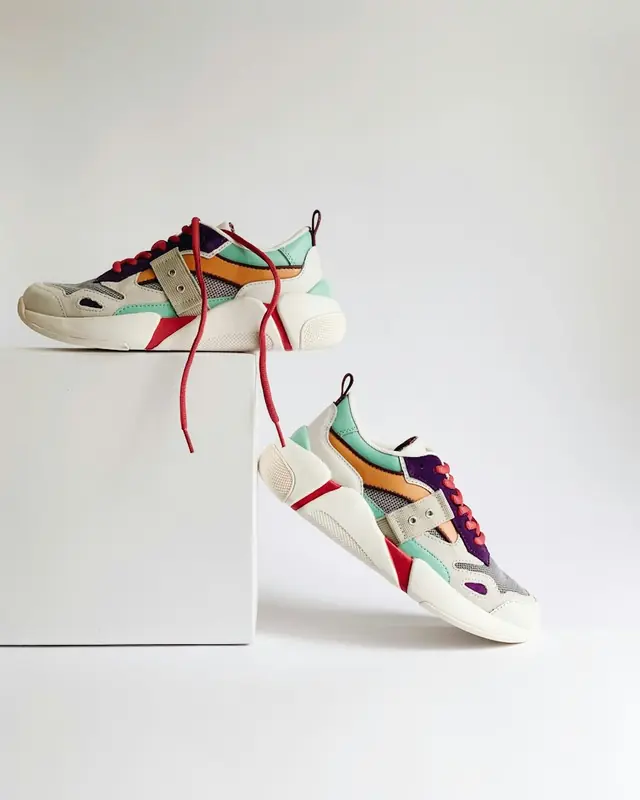


We are an AI content studio. Everything below starts from the same material: your product photos, your brand kit and whatever is already winning in your ad account. Most clients start with AI UGC ads and AI video ads, because that is where a shortage of creative costs money every day. AI product photos and AI social media content usually follow, because a hook that wins in a paid placement tends to work as a reel or a product-page image too.
Presenter-led, creator-style ads with licensed AI presenters. Scripted against what already sells in your account and cut for the first 1.5 seconds.
Product demos, unboxings, before-and-afters and offer-led cuts, generated from your product photos and footage. No studio day, no reshoot.
Lifestyle scenes, seasonal sets and feed statics built from one clean packshot, for ads, product pages and marketplace listings.
Reels, TikToks, Shorts and carousels for your organic channels, in your brand voice, so the account stays alive between campaigns.
Explainers, onboarding and sales videos voiced by a licensed avatar, or by your founder's own likeness with their signed consent.
A winning ad re-voiced and re-cut for new markets at roughly a third of the cost of a reshoot, with native voice and on-screen text.
Video and UGC ads are most of what we ship. The hook library, the model stack, testing with your buyer and the first ninety days have their own page.
AI video ads in depthMost accounts we audit are not short of budget. They are short of ads worth spending it on.
Paid social wears creative out. An ad that works gets more delivery, the same people see it more often, and its results decay until the buyer needs a replacement. When the next batch is weeks away, the buyer holds spend back to protect the last ad still working. The budget exists; the supply does not.
Helio Home was in exactly that position: six new creatives a month from a studio shoot with a six-week lead time, topped up with influencer videos at $400 to $900 each. Twelve months after moving to AI content, the account was taking sixty new ads a month on a five-day lead time. Blended ROAS had moved from 1.9x to 3.1x and cost per acquisition was down 41%, on their own account data.
The price per finished ad is the obvious difference. A shoot day at $12,000 to $30,000 buys six to ten hero cuts. A creator video costs $400 to $900 before usage rights. Our finished ads cost $120 to $175 each, depending on volume.
What that gap buys matters more than the gap itself. Cheap attempts mean four hooks tested where you used to test one, a tired ad replaced the week it tires, and a winner re-cut for a new market without a reshoot. Organic accounts have the same problem in a quieter form: they go silent between campaigns because nobody has time to feed them.
Ten business days from brief to the first finished batch, then a drop on the same day every week.
Send product photos, your brand kit and read access to the ad account. We study what already wins.
Concepts and hooks written against your best performers. You approve before anything is generated.
Ads generated, checked frame by frame for hands, text and continuity. Anything that fails is cut, not shipped.
Finished ads in every ratio, named for your ad manager. Results feed the next week's scripts.
Nothing is written from a blank page. The first thing we ask for is read access to your ad account, and the first thing we do is read it: which ads carried spend, which died inside three days, which offer survived a budget increase. Scripts are written against that, and you approve them before anything is generated, because a rejected script costs minutes and a rejected video costs a day.
Every ad leaves tagged by hook, format and offer. When your buyer reports back, we know which idea carried the result rather than which file did, and next week’s scripts start from there. That loop is what separates a retainer from a string of one-off batches.
What we need to start
The last item moves the timeline more than the other four combined.
You own all of it outright. No licence expires, no usage window needs renewing, and if you stop working with us the library and the source files go with you.
Named by brand, hook, format, version and ratio, so a result six weeks later still points at the idea behind it.
Generation is cheap enough to overproduce, so we do, and then we cut. Every video is checked frame by frame for hands, teeth, warped text, continuity breaks between shots, lip-sync drift and the blink pattern that makes people scroll without knowing why. Anything that fails is cut, not patched to make the count.
Product fidelity gets its own pass. Image models redraw labels, soften logos and shift colours a few shades, and an ad that shows the wrong product is worse than no ad. Where a model gets the product wrong, we composite your real packshot back in or drop the shot.
The final edit is done by a person. The team doing it has a decade of interface design behind it, which is why type sits where it should and the first frame still reads at thumb size.
What we will not ship
None of these is a matter of taste. Each is the kind of mistake that gets an ad account restricted or a brand in front of a regulator, and no hook fixes either.
Arclight’s sixty variants a month and Fairway Games’ 120 localised ad sets across six markets are delivery counts from our production records. Helio Home’s figures are performance, taken from their own ad accounts.
Twelve months of account data from Helio Home's Meta and TikTok ad accounts, compared with the twelve months before.
“We went from six new creatives a month to sixty. The testing calendar finally runs ahead of spend, not behind it.”
Priced in finished ads, because finished ads are what you are buying. Start with one pilot batch, then choose the monthly volume your buyer can actually test.
The pilot is deliberately small: twelve ads, one product, one market, no commitment. It answers one question, whether AI content suits your product, before you commit a month’s budget to it. Starter costs more per ad than the pilot because it includes the weekly loop of reading results and writing the next scripts against them.
Retainers are monthly with thirty days’ notice, no annual contract and no setup fee. Cost per ad falls as volume rises because the hook library and the presenter set are built once and reused.
Four sensible routes to more content, and each one wins somewhere, including the three that are not us.
Six to ten hero cuts, roughly six weeks from brief to files. Complete control of every frame, all of it paid for before anyone knows which idea works.
Wins when: Texture, food, fabric and choreography, and the few brand assets a year that have to look expensive.
A real person on camera, with usage rights often billed on top and turnaround set by the creator's calendar. One interpretation of each brief.
Wins when: The person is the proof: results on a real face, a creator whose audience is the reason to buy, a launch that needs a name attached.
The lowest cash cost there is. The tool generates; the hooks, cuts, captions, checks and uploads are yours.
Wins when: Someone on your team has spare hours and a good eye. If that is you, buy the tool and keep the $1,800.
Twelve ads in ten business days, then 20 to 100 a month, scripted against your account, checked and tagged. No real faces and no hands-on product demos.
Wins when: Creative supply is what caps your spend, and you want files your buyer can upload the morning they arrive.
Most accounts that work end up running a mix: AI content for volume, testing and localisation, two or three creators for trust, and a shoot for the assets that carry the brand. The hook library connects them, because whatever wins in the volume layer becomes the brief for the expensive production. The AI UGC vs human UGC comparison draws that line in detail.
The creator range is what Helio Home paid before switching. Shoot-day and tool ranges are 2026 market rates, so check them against your own quotes.
AI content is where most clients start. The rest of the team is there for the work the content creates.
The manual work between your systems, removed. Pilot workflows go live in three weeks.
Sixty ads a month create a reporting job nobody owns. A good first automation pulls results from Meta and TikTok, joins them to our hook tags and writes the weekly read that your buyer and our scripts both work from. Audits are $2,000 for a week; pilot workflows run $4,000 to $9,000 and go live in three weeks.
AI agents, assistants and LLM features built into the software you already run.
For when the content needs a product behind it: a catalogue pipeline that generates listing images for every SKU, or an assistant that answers the questions your ads raise. Builds start with two weeks of scoping at $5,000.
More from the same team
Social media marketing is the one content clients add most: we post what we make, run the calendar and report on what it earned. It is quoted after a free account review and costs less alongside a content retainer.
We post the content we make, run the calendar and report on what it earned.
Web apps, internal tools and customer products, designed and built by one team.
iOS and Android apps, native or cross-platform, from prototype to the app stores.
Security reviews, penetration testing and hardening, plus a free website scan.
AI content creation, or AI content generation, is making marketing assets such as ads, product photos, social posts and explainer videos with generative image, video and voice models. Done properly, people still do the parts that decide results: picking the angle, writing the hook, directing the generation, checking every frame and cutting the final edit. As an AI content studio we sell the finished assets, not access to the models.
Our pilot batch is $1,800 for 12 finished ads, delivered in ten business days with no commitment. Monthly retainers run from $3,500 for 20 ads to $8,000 for 60, and from $12,000 for 100 ads including one localised market, with each further market $4,000 a month. That works out at $120 to $175 per finished ad.
If someone on your team has the hours, you should consider it. Self-serve UGC tools cost $99 to $399 a month and the generation step is genuinely good now. What the subscription does not include is the hook writing, the account read, the frame-by-frame checks, the platform cuts and the tagging that lets results feed the next batch. That work is what the batch price pays for.
Yes. One clean packshot on a plain background is enough to build lifestyle scenes, seasonal sets and feed statics for ads, product pages and marketplace listings. We check each image against the real product for label text, logo, colour and proportions, and composite the original packshot back in wherever a model has redrawn it.
No. Presenters are AI-generated and licensed for commercial advertising use. If you want a real face, such as a founder or a member of staff, we work from their own footage or a licensed avatar of them, and only with their signed consent on file before production starts. A custom avatar trained on one person is quoted separately, because it involves training rather than prompting.
Where a platform requires a synthetic media label, yes. We apply it and design the opening so the label does not bury the hook. Beyond platform rules it depends on your category and your regulator. We do not give legal advice, so anything touching health, finance, employment or housing goes to your legal contact before it ships.
Your brand kit sets the fonts, colours, logo placement and tone, and you approve every script before anything is generated. Presenters and settings are chosen per account and reused, so the tenth batch looks like the same brand as the first. On Scale and above, the presenter set is reserved for your brand.
You do, outright: the finished files, the layered source files, the project files and the hook library. There is no licence that expires and no usage window to renew. If you stop working with us, everything goes with you and another team can pick it up.
We do not buy media. Your in-house buyer or agency runs the ads, and we build the testing plan with them so each batch produces a readable result. We can post the organic side: social media marketing runs the calendar and reports on what it earned. It is quoted after a free account review and costs less when added to a content retainer.
You have spent $1,800 finding out, with no retainer to cancel. We will tell you what we think went wrong, whether that is the format, the offer or the landing page. Some products simply do not suit generated presenters, and the pilot is the cheapest honest way to learn that. If you do move to a retainer, it runs monthly with thirty days' notice.
Send a product link and the ads you are running now. Alex Novak, delivery director, replies within one business day with the hook angles we would test first.